Most organisations know who works for them, but far fewer can confidently answer a more important set of questions:
-
What can those people do?
-
What are they qualified to do?
-
What do they still need to learn?
-
And is the training that allows them to perform their role still current?
Those questions are becoming harder to ignore. LinkedIn's 2025 UK Workplace Learning Report found that 57% of learning and talent development professionals said executives were concerned employees didn't have the right skills to execute their business strategy.
Official UK data tells a similar story. The Employer Skills Survey 2024 found that 27% of vacancies were affected by skills shortages, while 12% of employers reported at least one employee who wasn't fully proficient in their role. At the same time, the proportion of employers providing training has fallen, from 66% in 2017 to 59% in 2024.
The answer isn't simply finding more people to fill skills gaps. Organisations also need to develop more of the capability they already have.
Learning cannot remain a separate activity that sits in an isolated Learning Management System (LMS), maintained by L&D and reviewed once someone needs a certificate. It needs to form part of the wider employee record.
For HR leaders, the opportunity is to connect learning, skills, performance, HR compliance and workforce planning, so the organisation can understand not only who it employs, but the capability available across the workforce.
The skills problem is becoming a workforce problem
The traditional response to a skills shortage has often been recruitment. Find someone who already has the capability the organisation needs. While that sometimes remains the right answer, recruitment cannot solve every skills problem, particularly when many businesses are competing for the same experience and qualifications.
The Employer Skills Survey found that 6% of UK employers had at least one skills-shortage vacancy in 2024. More than a quarter of all vacancies affected by employers were classified as skills-shortage vacancies, meaning they were difficult to fill because applicants lacked the required skills, qualifications or experience.
Existing employees also have development requirements. A skills gap doesn't necessarily mean someone is unsuitable for their role. They may be new, taking on additional responsibilities, adapting to new technology or developing into a more senior position.
The organisation then has a choice:
-
Keep looking externally for capability
-
Or develop more of it internally
That second option requires better visibility of learning. It means knowing what skills already exist, where the gaps are and whether training is actually addressing them.
And the pressure to make that investment count is increasing.
Research published by the Learning and Work Institute in September 2026 found that employer investment in training per employee fell 29% between 2011 and 2024, while the average amount of training received by each trainee fell from 7.8 days to 5.7 days.
Businesses are trying to solve more complex skills problems while investing less time and money in development.
Training has historically sat apart from the rest of HR
Part of the workforce training problem is technological.
The same employee exists in every system, but the organisation doesn't necessarily have one complete picture of that person.
Consider an employee who completes additional technical training. The LMS knows they completed a course,
-
But does their manager know?
-
Does their employee record reflect it?
-
Does the Skills Matrix change?
-
Can Operations use that information when deciding who is capable of covering particular work?
-
Does their next performance review take the development into account?
If the answer to those questions depends on someone exporting a report and updating another system manually, the value of the learning data is being restricted.
The course has been completed, the organisation has gained new capability, but its workforce systems may not know that.
The value of learning is what changes afterwards
This is where organisations should think differently about Learning Management Software. An LMS should certainly make it easier to create courses, assign training, deliver content and track completion, but completion of the training isn't the final outcome.
The business outcome comes from what the employee can do afterwards. Perhaps they can:
-
Operate a new piece of equipment
-
Move into another role
-
Supervise another employee
-
Work on a particular project
-
Meet a regulatory requirement
-
Take on greater responsibility
-
Address a development need identified during a performance review
Learning becomes significantly more valuable when the resulting information can influence wider workforce decisions. That's why training data belongs closer to the HRMS.
Compliance training shows why the connection matters
Mandatory training makes the problem particularly visible. Knowing that your organisation has a health and safety course isn't enough. You need to know who requires it, whether they completed it, if they passed any required assessment, if their certification remains current, and when retraining is required.
The Health and Safety Executive describes competence as a combination of training, skills, experience and knowledge, together with someone's ability to apply them to perform work safely. Employers are expected to consider employee competence when deciding what information, instruction, training and supervision are required.
Course completion and workforce competence aren't automatically the same thing. An LMS provides important evidence that learning took place, but HR and operational leaders may need wider information before deciding that someone is ready to carry out particular work.
That could include experience, qualifications, previous training, observed performance or role requirements.
The stronger model is therefore not an isolated LMS, it's learning information connected with the wider employee and workforce record.
Skills should influence workforce decisions
Imagine a manufacturer preparing tomorrow's production rota. The business has enough employees available numerically, but only three people have the training required to operate a particular machine. Two are absent. The problem is no longer headcount, it's capability.
A similar issue might arise on a construction project where only particular employees have the qualifications or training required for certain work.
In healthcare, a manager may have several employees available but need people with particular role-specific training to provide the required service safely.
Traditional scheduling answers who is available, but skills-led workforce management asks who is available and capable of doing the work.
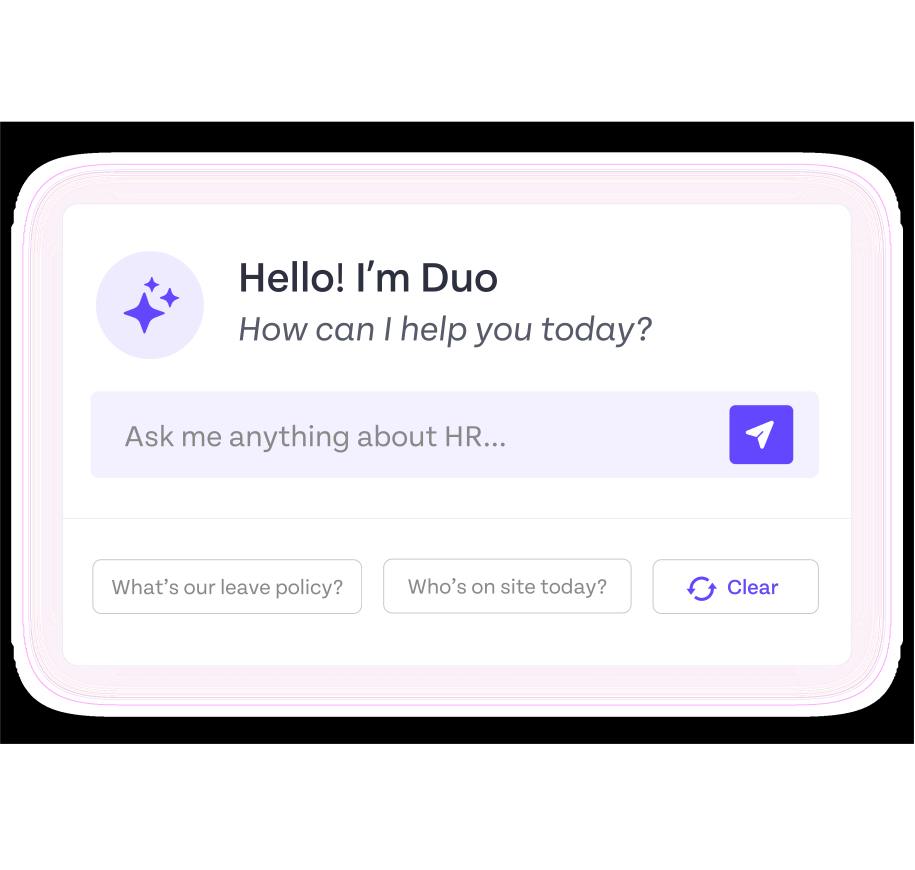
HR Duo already connects workforce information through capabilities such as Skills Matrix, Employee Profiles, Digital Rotas, Shift Scheduling and Time Tracking. Adding Learning Management creates another important part of that workforce picture.
Training can help build capability, and skills information can help make that capability visible.
Learning should begin during onboarding
Learning shouldn't suddenly begin several weeks after somebody joins. The development journey starts much earlier.
-
Recruitment establishes what skills and experience someone brings into the organisation
-
Onboarding introduces them to the company, their role and the expectations around their work.
-
Training then develops what they need to know next.
Treating recruitment, onboarding and training as independent processes creates repeated administration. Where a more connected employee lifecycle allows that journey to move naturally through: Recruitment, Onboarding, Learning, Performance, Development.
That's one of the reasons HR Duo has added Learning Management to its wider Talent Management capabilities. Learning becomes another stage of the employee journey rather, than another system HR needs to maintain.
Performance should feed the learning process too. If a one-to-one, performance review or new objective identifies a development requirement, the process shouldn't end with a note saying “training required”. Connecting learning management with performance gives managers a clearer route from identifying a skills gap to helping the employee develop it.
Career development matters for retention
Employees have their own reasons for wanting to learn. Career progress was identified by LinkedIn as the leading motivation for learning globally in its 2025 Workplace Learning research. The UK report found that organisations with more developed career programmes were more confident in their ability to attract and retain talent, while 91% of UK L&D professionals agreed continuous learning had become more important for career success.
That should make learning part of the retention conversation.
Employees don't necessarily want a catalogue containing thousands of courses. They want to understand how development relates to where they can go next.
Learning becomes more meaningful when employees can see a connection between:
That requires L&D and performance management to work together.
Mandatory training requires more than a spreadsheet
Many organisations still manage part of their training estate manually, which becomes increasingly difficult as the organisation grows across hundreds or thousands of employees, roles and locations.
Training records also need to remain useful after a course is completed. Certifications can expire and mandatory learning may need to be repeated, so HR needs visibility of upcoming renewals as well as initial completion. HR Duo allows organisations to monitor certifications and recertification requirements alongside the wider employee record, helping teams identify gaps before required learning falls out of date.
A Learning Management System can automate much of that administration.
HR Duo allows organisations to assign learning to individuals or employee groups, automatically enrol predefined groups, set deadlines and reminders, schedule classroom or virtual training and track completion.
Training can include videos, quizzes, assignments, webinars, instructor-led sessions and imported SCORM, xAPI and TinCan learning content. Courses can also be organised into structured learning journeys rather than isolated activities.
The practical value isn't having online courses, it's having a repeatable process for getting required learning to the right people and understanding what happened afterwards.
Training records also need to remain useful after a course is completed. Certifications can expire and mandatory learning may need to be repeated, so HR needs visibility of upcoming renewals as well as initial completion. HR Duo allows organisations to monitor certifications and recertification requirements alongside the wider employee record, helping teams identify gaps before required learning falls out of date.
Learning needs to work for frontline employees
Learning technology can also fail for a much simpler reason. Employees cannot easily access it.
This matters particularly in manufacturing, construction, healthcare and other operational sectors, where a significant part of the workforce may not have a company laptop.
Some employees rarely use email during their working day, others move between sites. Training may need to fit around shifts rather than a conventional office schedule.
If accessing learning requires finding an old login, visiting another platform and completing training on a desktop computer, participation becomes harder than it needs to be.
Employees can access assigned learning through HR Duo across desktop and mobile devices. They can receive notifications about assignments, deadlines and upcoming learning events, complete interactive content and earn certificates and badges as they progress.
Gamification can add a visible sense of progress and achievement to the employee learning experience.
But the more important principle is accessibility. Training should be available to the workforce that actually needs it, wherever those employees work.
Learning data should form part of the employee record
This is arguably the central issue, as most organisations don't need more disconnected workforce data. They need more useful connections between the information they already collect.
-
The employee record tells you who somebody is
-
Recruitment data tells you what experience they brought into the organisation
-
Onboarding tells you how they entered the role
-
Learning records show what development they have completed
-
Skills information shows available capability
-
Performance management provides evidence of progress and future needs
-
Workforce Operations shows how that employee is deployed in practice
When those records are viewed together, HR gains something much more useful than a list of completed courses, it begins to build a picture of workforce capability.
That creates better questions.
-
Where are our biggest skills gaps?
-
Which teams require more development?
-
Who could progress into a future role?
-
Which employees require recertification?
-
Where are we relying too heavily on a small number of skilled people?
-
Is training translating into improved performance?
-
What capability do we need to build rather than recruit?
An LMS should support development, not become a certificate factory
There is an important caveat when moving to an LMS. Buying Learning Management Software will not solve a skills problem by itself.
The Learning and Work Institute's concerns about shorter, compliance-heavy training are useful here.
Technology makes it easier to distribute learning, but that doesn't automatically make the learning relevant. Organisations still need to understand what capabilities they require, design appropriate development, give employees time to learn and check whether the learning has worked.
The HSE makes a similar point in its employer guidance: employers should determine what training is needed, choose appropriate methods, deliver it and then check whether the training has been effective.
The goal shouldn't be to maximise the number of green ticks on an LMS dashboard, it should be to build a safer, more capable and better-prepared workforce.
What should employers look for in Learning Management Software?
An organisation assessing employee training software should look beyond course libraries and content formats. You should be asking whether the LMS can support how your workforce actually learns.
-
Can training be assigned by employee or group?
-
Can onboarding learning be structured into journeys?
-
Can mandatory courses have deadlines and reminders?
-
Can classroom and virtual training sit alongside e-learning?
-
Can certifications and renewals be tracked?
-
Can employees access learning easily from mobile devices?
-
Can managers identify outstanding training?
-
Can learning information form part of the wider employee record?
-
Can training connect with skills, performance and development?
-
Can HR report on learning across different parts of the workforce?
The answers help distinguish a system that simply delivers courses from one that contributes to wider talent management.
.svg)